Paris-Brest has a reputation problem. People assume it belongs in the window of a Parisian pâtisserie — handled by someone with a CAP diploma and a decade of muscle memory — not in a home kitchen on a Tuesday. That assumption is wrong, and the craquelin is the reason why.
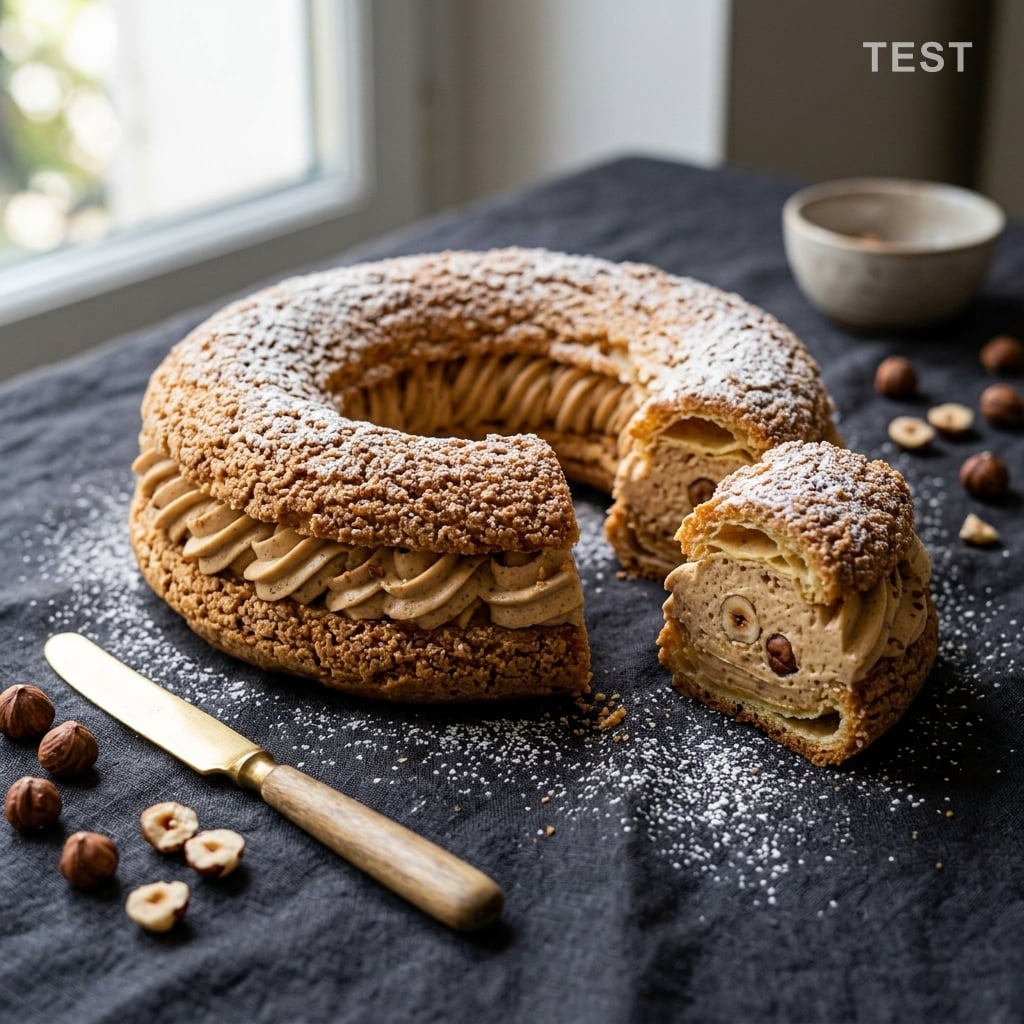
What comes out of the oven when you add craquelin to choux is structurally different from plain choux. The thin disc of cold butter, sugar, and flour melts slowly as the pastry puffs, forming a caramelized crust that cracks along natural fault lines — bronze-gold, slightly irregular, with a faint smell of toasted hazelnut before the praline cream even enters the picture. It looks technically accomplished because it is technically accomplished, even when it isn’t. That gap between appearance and effort is, honestly, the whole point.
Why you’ll love this recipe
Ingredient Notes
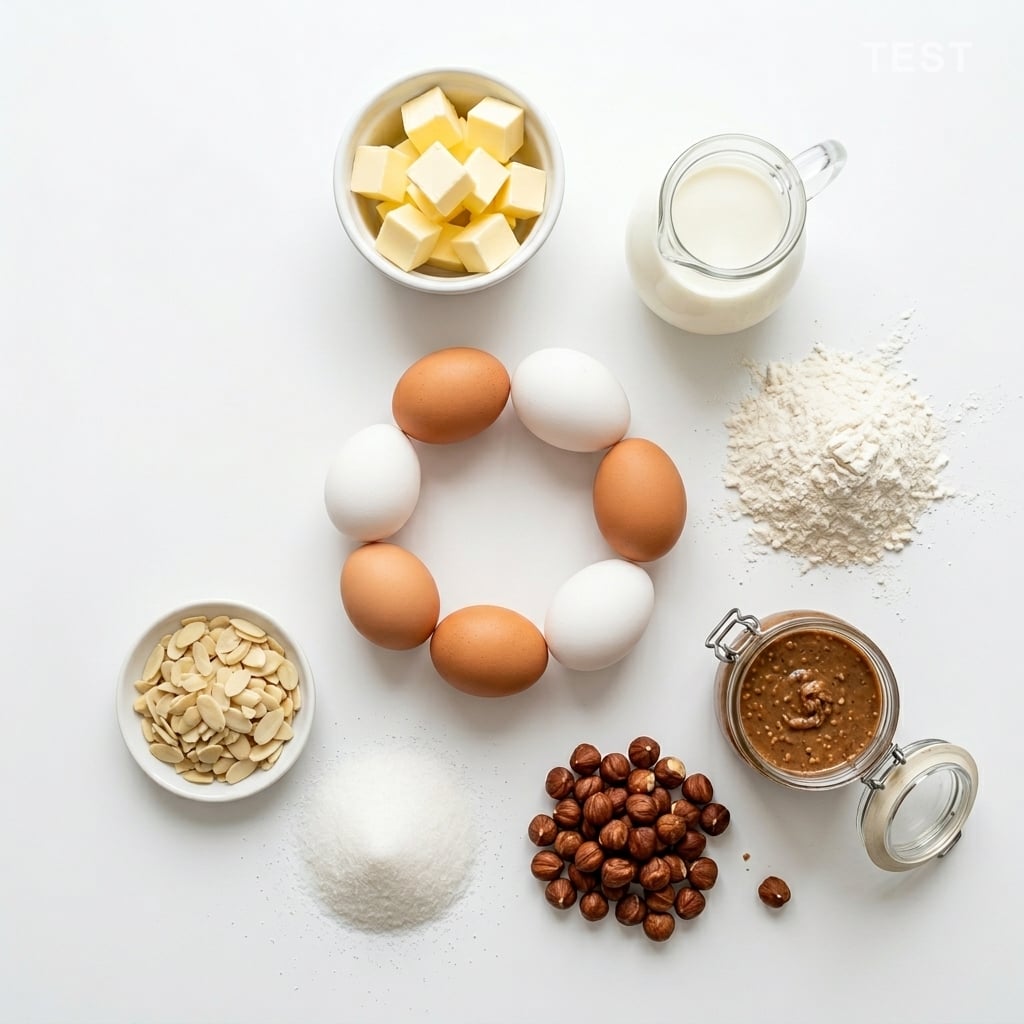
The short list: eggs, butter, flour, hazelnuts, praline paste — and the craquelin, which asks for almost nothing but repays everything.
- Praline paste : This is the core flavor of the filling. If you can find a good commercial praline paste — look for ones where hazelnuts are listed first, ahead of sugar — use it. Homemade is worth making if you have time: roast hazelnuts until the skins blister and crack, caramelize sugar to a dark amber, blend until smooth. The bitterness of the caramel is what keeps the filling from tasting flat.
- Eggs, for the choux : The ratio that matters most: you are looking for a batter that falls in a slow, thick ribbon from a lifted spoon. Too little egg and the choux won’t puff; too much and it spreads flat. Add them one at a time and check the consistency after each. Large eggs weigh roughly 50–55g — this matters because the hydration of the dough determines everything. You are targeting roughly 55–60% hydration in the finished paste.
- Butter, cold, for the craquelin : Cold is not optional here. The craquelin works because the butter stays solid long enough to be rolled thin and cut cleanly. If it softens, the dough tears and sticks to everything. Work quickly, roll between two sheets of parchment, and freeze the cut rings for at least thirty minutes before placing them on the raw choux.
- Whole milk, for the pastry cream : Full-fat milk only. The fat content carries the flavor and gives the pastry cream its body. The praline paste is already rich, so the base cream doesn’t need to be extraordinary — but it does need to cook long enough that the starch fully gelatinizes, or it will thin out when you beat in the butter later.
- Whole hazelnuts, for garnish : A handful of hazelnuts caramelized in sugar and roughly broken up gives the finished Paris-Brest a second texture and makes the flavor legible at first glance. Press them gently into the piped cream just before serving — they soften overnight in the refrigerator, so don’t add them too early.
Make the Craquelin the Night Before — Then Forget About It
The craquelin is 50g cold butter, 60g brown sugar, and 60g plain flour, worked together into a dough and rolled to 2–3mm between two sheets of parchment. It should smell faintly of shortbread at this stage — pale, slightly sandy, with a texture that holds its shape when you cut it. Punch out rings slightly larger than your piped choux, roughly 8–9cm in diameter for a standard Paris-Brest. Stack them with parchment between each layer and freeze until solid. This can be done three days in advance with no loss of quality. When you place a frozen craquelin ring directly onto freshly piped raw choux and slide the whole thing into a hot oven, the butter melts at a controlled rate while the choux steams and expands beneath it. It works because the cold craquelin slows the surface from setting too fast, giving the pastry time to lift before the crust locks in place. The result is that characteristic fractured, caramelized shell — bronze and slightly uneven, which is exactly as it should be.
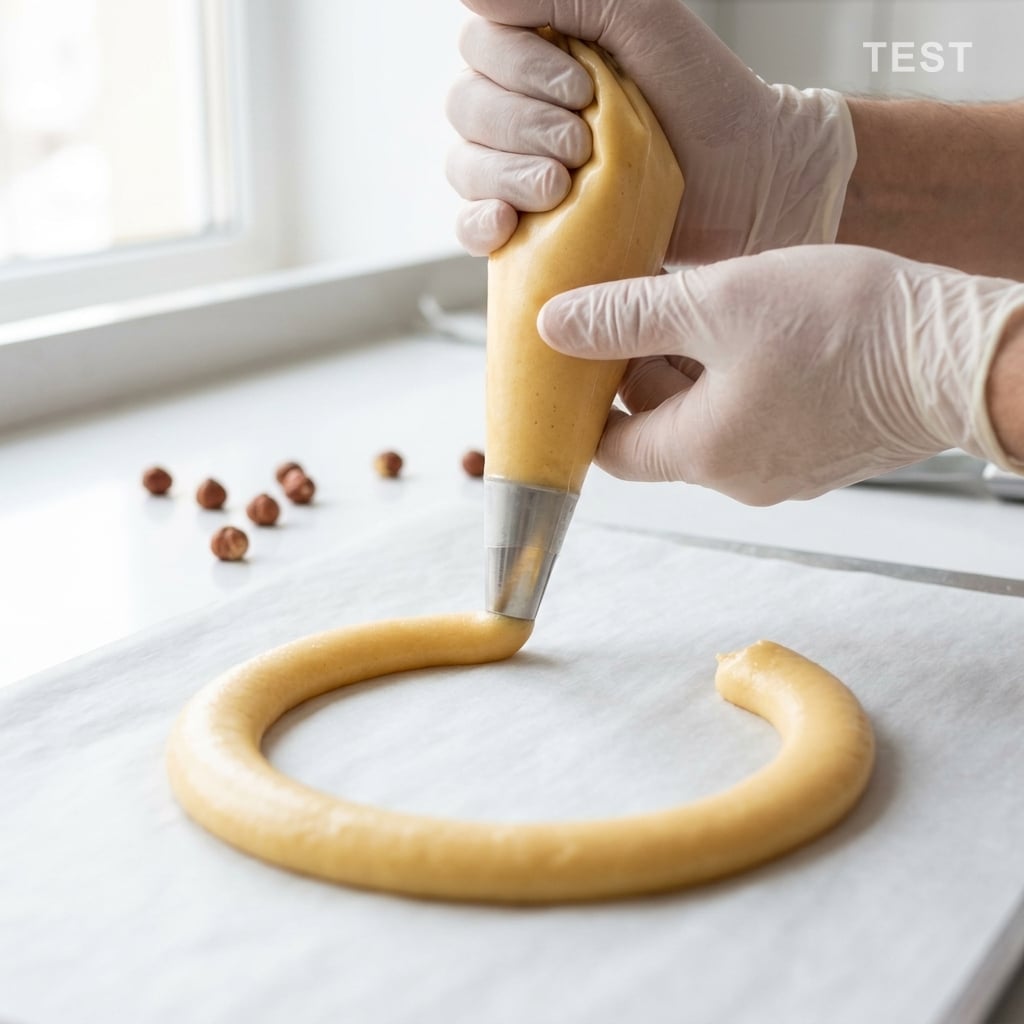
Don’t Open the Oven for the First 25 Minutes
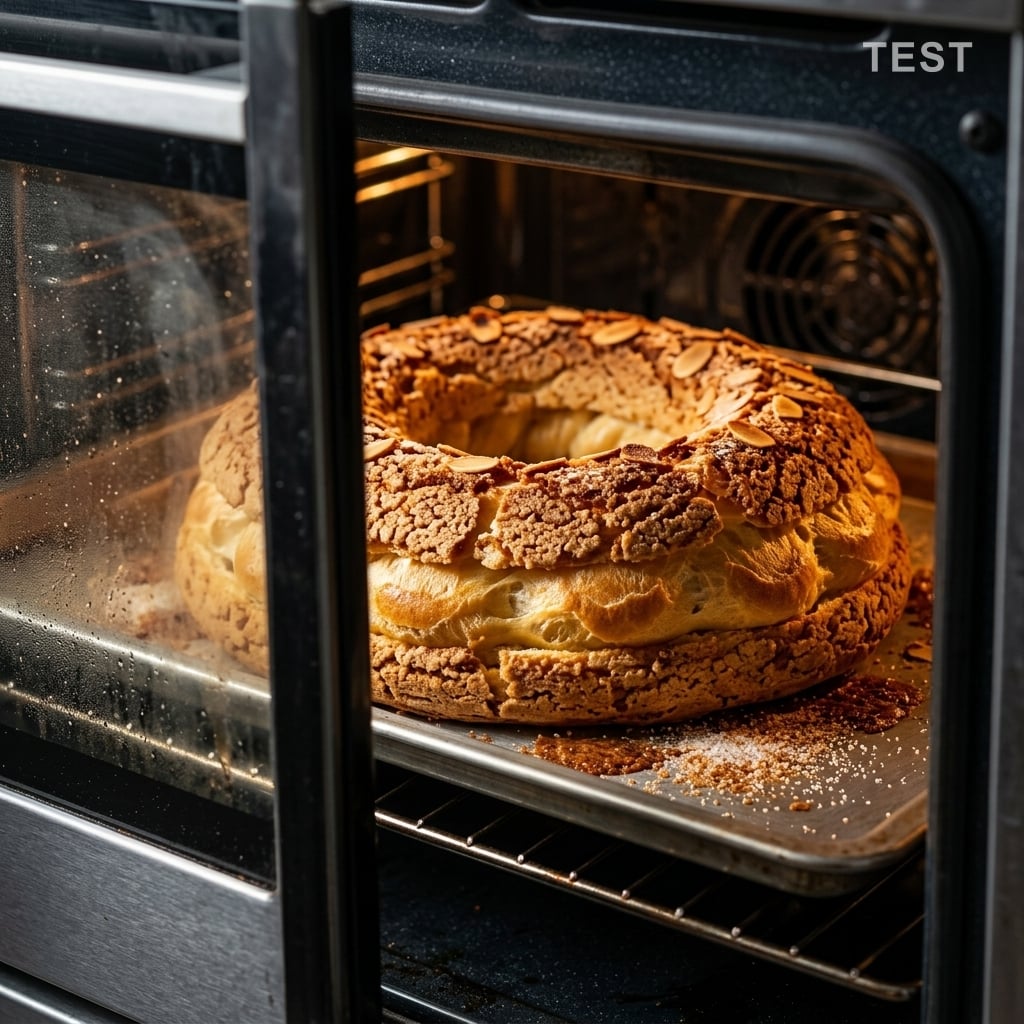
Choux is steam-leavened. The moisture in the batter turns to steam inside the hot oven and pushes the pastry up and outward, creating the hollow interior that makes the whole structure work. If you open the oven before this structure sets, the steam escapes, the pressure drops, and the ring collapses. Set the oven to 190°C fan — or 200°C static — and leave it alone. You will hear cracking sounds around the fifteen-minute mark: that is the craquelin splitting as the choux pushes through. This is correct. After 30–35 minutes, the rings should be a deep, uniform gold with a dry, hollow sound when you tap the base. If they sound dense, give them five more minutes. Pull them from the oven and immediately pierce the underside of each ring with a skewer to release residual steam. Then let them cool completely on a wire rack before you do anything else.
The craquelin doesn’t just improve the look of the choux. It changes the internal structure — the crust controls how the steam escapes, which changes how the pastry sets.
Your Pastry Cream Needs to Be Properly Cold Before the Butter Goes In
Mousseline is a pastry cream beaten with softened butter — typically at a ratio of around 30% butter to 100% pastry cream by weight. The chemistry is straightforward: both components need to be at roughly the same temperature for the emulsion to hold. If your pastry cream is still warm and your butter is cold, you get lumps. If your butter is melted and your cream is cold, you get a greasy split. The target is 18–20°C for both. Make the pastry cream the day before, press plastic wrap directly onto its surface to prevent a skin from forming, and refrigerate overnight. The next day, let it come up to room temperature for thirty minutes while your butter softens on the counter. Beat the cream in a stand mixer until it loosens and becomes smooth again, add the praline paste, then add the butter a tablespoon at a time. The finished mousseline should be pale, almost mousse-like, with a clean hazelnut scent and enough body to hold a stiff peak without slumping.
Cut, Fill, and Don’t Second-Guess Yourself
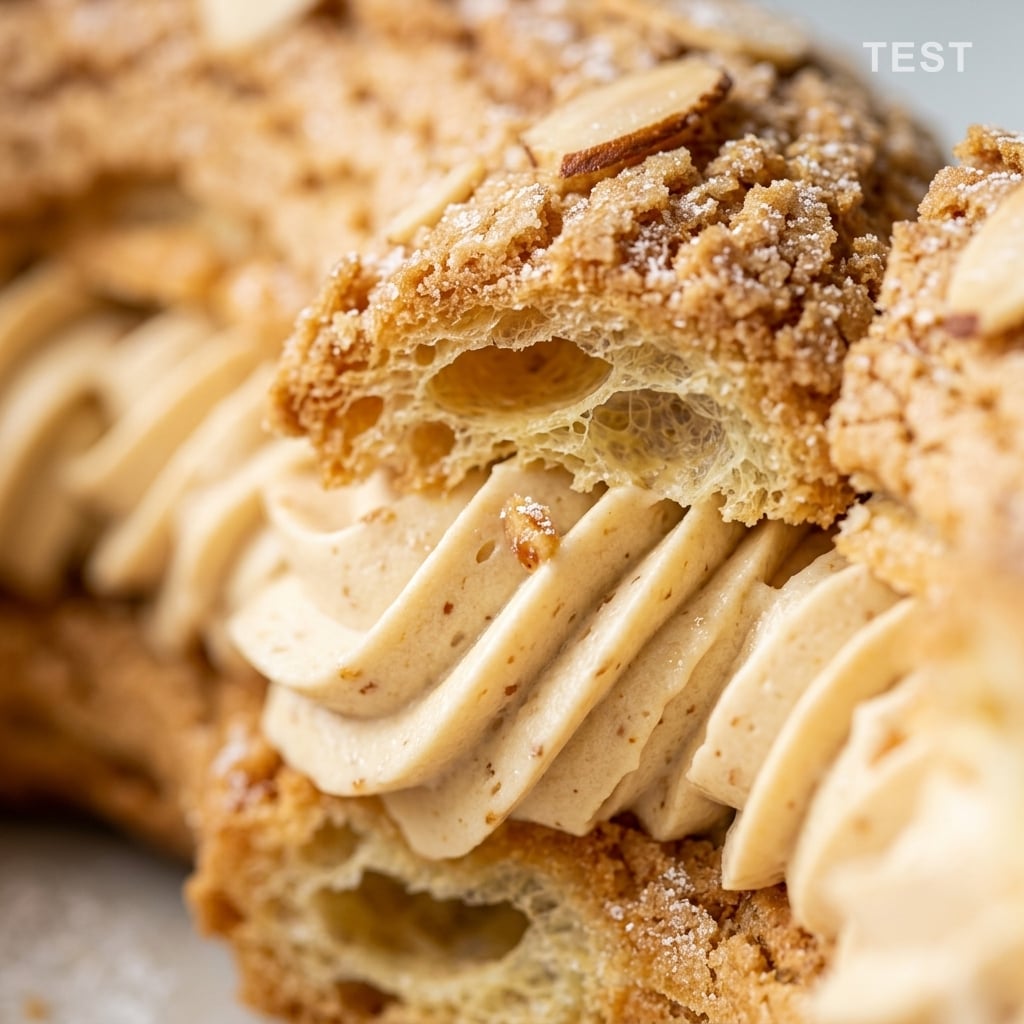
Using a serrated knife, cut each choux ring horizontally, keeping the top and base as level as possible. The interior will be hollow — this is what you want, and what you built the whole structure for. Transfer the mousseline to a piping bag fitted with a large star nozzle and pipe in a continuous spiral around the base ring, starting from the outer edge and working inward. The filling should reach the full height of the base; don’t try to overfill or the lid won’t sit flush. Replace the craquelin top, dust lightly with powdered sugar, and press the caramelized hazelnut pieces into the mousseline where it shows beneath the lid. Refrigerate for at least one hour before serving — the mousseline firms slightly, the choux softens fractionally against the cream, and the structure becomes easier to cut cleanly. The flavors also settle. That hour is not optional rest; it is part of the recipe.
Tips & Tricks
- Freeze the craquelin already placed on the piped choux ring, not separately. Pipe your rings onto the baking tray, lay the craquelin discs on top, then chill the whole assembly for ten minutes before it goes into the oven. The extra cold gives the structure more stability in the first burst of heat.
- If your mousseline looks split or curdled after adding the butter, it is almost certainly a temperature mismatch. Place the bowl over very low heat for ten seconds at a time and beat between each interval — it will come back together. Don’t panic, don’t add more butter.
- The Paris-Brest is at its best the day it is assembled, but it holds overnight in the refrigerator. The craquelin softens considerably by day two. The filling, however, improves — the praline flavor deepens and rounds out with time.
Can I make the Paris-Brest a day in advance?
Yes, with one caveat. The craquelin crust softens noticeably overnight in the refrigerator — it goes from a clean shatter to a slightly yielding bite. The filling actually improves with time, and the ring is perfectly serviceable the next day. If the crust texture matters to you, assemble on the day and refrigerate for the minimum one hour.
What if I can’t find praline paste?
You can make it at home: roast 200g of hazelnuts at 170°C until the skins crack and the flesh is golden, rub off the skins, then caramelize 150g of caster sugar to a dark amber, pour it over the hazelnuts on an oiled tray, let it set hard, and blend the whole block to a smooth paste. It takes about twenty minutes and keeps refrigerated for two weeks. A good hazelnut butter (100% hazelnuts, no additives) mixed with two tablespoons of caramel sauce is a workable shortcut, though the flavor will be flatter.
My choux didn’t puff — what went wrong?
Three likely causes. First: the oven wasn’t hot enough, or you opened it before the structure set — both let the steam escape prematurely. Second: the dough was too wet, meaning too many eggs for the flour weight, so it couldn’t hold its shape. Third: the dough wasn’t dried out enough in the pan before the eggs went in — you need to cook the paste over medium heat until it pulls cleanly away from the sides and a film forms on the bottom of the pan.
Can I make individual Paris-Brest rings instead of one large one?
Yes, and it’s often easier to portion cleanly. Pipe 7–8cm rings for individual servings, adjust the craquelin discs accordingly, and reduce the baking time by about 5 minutes. Check earlier and trust the hollow tap test over the clock. The mousseline quantity in this recipe is calibrated for one large ring; for individual rings, you may have cream left over.
My mousseline split when I added the butter. Can I fix it?
Almost certainly yes. A split mousseline is a temperature problem: either the pastry cream was too cold and seized around the butter, or the butter was too warm and broke the emulsion. Set the bowl over a pan of barely simmering water for ten seconds at a time, beating between each interval. The friction and gentle warmth will bring the emulsion back together. Don’t add more butter and don’t rush it.
Does the craquelin technique work on other choux shapes?
It does, and it’s particularly useful on éclairs and cream puffs, where the craquelin controls the cracking direction and gives a more uniform shape. The principle is the same: roll thin, freeze solid, cut to fit, place directly on the raw piped dough before baking. The weight and cold of the craquelin also helps the choux hold its piped shape longer in the initial heat before it sets.
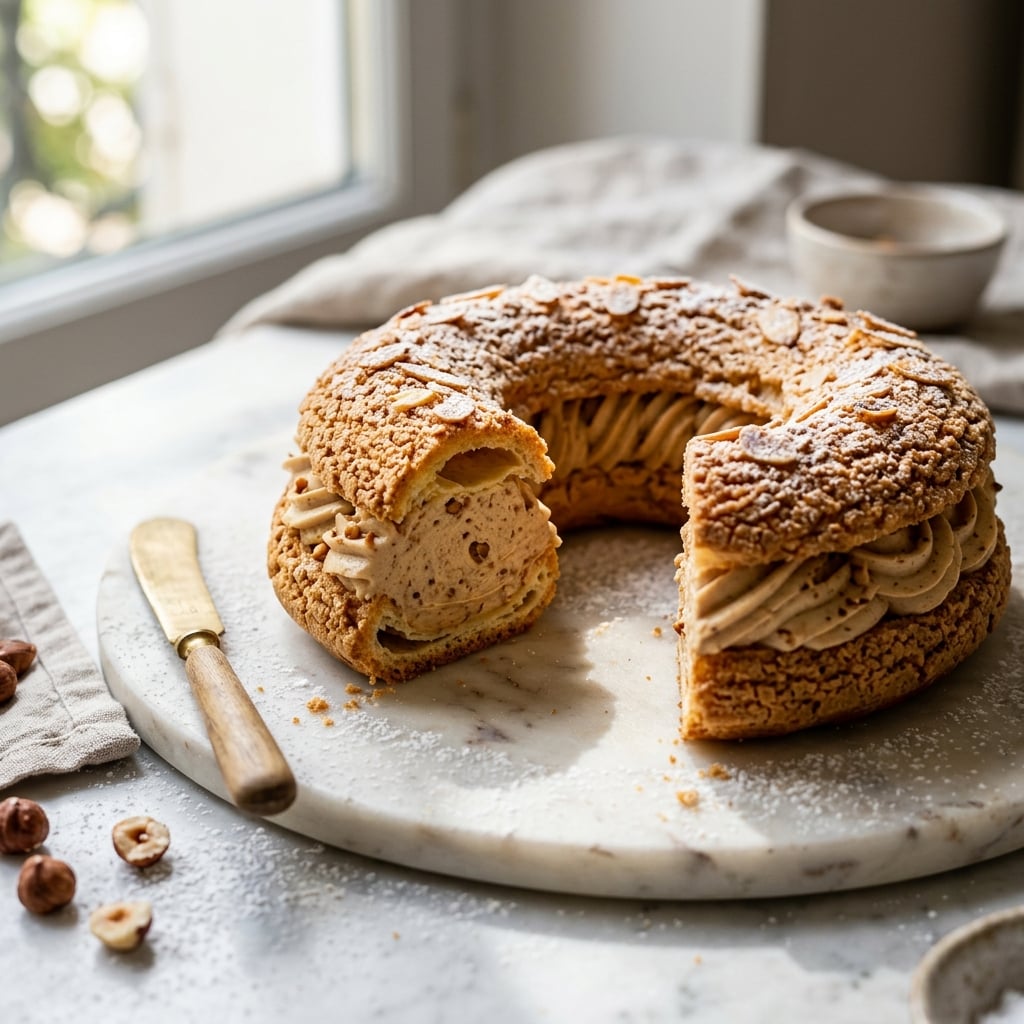
Paris-Brest with Craquelin
French
Pastry / Dessert
A choux ring topped with a cold butter-sugar-flour crust that caramelizes as the pastry puffs, filled with a hazelnut praline mousseline cream. The craquelin is not decoration — it changes how the choux bakes.
Ingredients
- — Craquelin —
- 50g cold unsalted butter, cubed
- 60g brown sugar (cassonade)
- 60g plain flour
- — Choux pastry —
- 125ml water
- 125ml whole milk
- 100g unsalted butter
- 1 tsp caster sugar
- ½ tsp fine salt
- 130g plain flour, sifted
- 4–5 large eggs (50–55g each)
- — Praline mousseline —
- 500ml whole milk
- 4 egg yolks
- 100g caster sugar
- 45g cornstarch
- 30g unsalted butter (for pastry cream)
- 120g hazelnut praline paste
- 150g unsalted butter, softened (for mousseline)
- — Garnish —
- 80g whole hazelnuts
- 30g caster sugar
- powdered sugar, for dusting
Instructions
- 1Make the craquelin: work the cold butter, brown sugar, and flour together with your fingertips until a dough forms. Roll to 2–3mm between two sheets of parchment. Cut out rings approximately 9cm in diameter. Stack between parchment layers and freeze for at least 30 minutes (or up to 3 days).
- 2Make the pastry cream: whisk egg yolks with sugar and cornstarch until pale. Heat milk in a saucepan until just simmering, then pour slowly onto the yolk mixture, whisking constantly. Return to the pan and cook over medium heat, whisking, until the cream thickens and bubbles (about 2 minutes). Remove from heat, stir in 30g butter. Press plastic wrap directly onto the surface and refrigerate overnight, or until the cream is below 20°C throughout.
- 3Caramelize the hazelnuts: cook 30g caster sugar in a dry pan over medium heat until amber. Add hazelnuts, coat quickly, pour onto a sheet of lightly oiled parchment. Once fully cold, break into rough pieces.
- 4Make the choux: preheat oven to 190°C fan (200°C static). Bring water, milk, butter, sugar, and salt to a rolling boil in a saucepan. Remove from heat and add the sifted flour all at once. Stir vigorously until fully combined. Return to medium heat and cook, stirring, for 2 minutes until the paste pulls cleanly away from the sides and a dry film forms on the pan base.
- 5Transfer the paste to a stand mixer bowl. Beat briefly to cool slightly (about 1 minute). Add eggs one at a time on medium speed, checking consistency after each: the finished dough should fall in a slow, thick ribbon from a lifted beater. You may need only 4 eggs.
- 6Transfer to a piping bag with a 1.5cm plain nozzle. Pipe two concentric rings, one on top of the other, onto a parchment-lined tray to form a ring about 22cm in diameter. Place a frozen craquelin ring over the top. Refrigerate the assembly for 10 minutes.
- 7Bake 30–35 minutes without opening the oven. The ring should be deeply golden and sound hollow when tapped on the base. Immediately pierce the underside in 6–8 places with a skewer. Cool completely on a wire rack.
- 8Finish the mousseline: beat the cold pastry cream in a stand mixer until smooth and even. Add the praline paste and beat to combine. Add the 150g softened butter one tablespoon at a time on medium speed. The finished mousseline should be pale, fluffy, and hold a stiff peak.
- 9Assemble: slice the cooled choux ring horizontally with a serrated knife. Transfer mousseline to a piping bag with a large star nozzle and pipe in a spiral over the base, starting from the outer edge. Replace the craquelin lid. Dust with powdered sugar and press caramelized hazelnut pieces into the exposed cream.
- 10Refrigerate for at least 1 hour before serving to allow the structure to firm and the flavors to settle.
Notes
• Temperature is everything in the mousseline. If either the pastry cream or the butter is more than a few degrees off from 18–20°C when you combine them, the emulsion will split. If it does, warm the bowl gently over simmering water and beat it back together — it will recover.
• The craquelin can be rolled, cut, and frozen up to 3 days in advance. The pastry cream can be made 24 hours ahead. On the day of serving, only the choux baking and the final assembly need your attention.
• If you cannot find hazelnut praline paste, make it: roast 200g hazelnuts at 170°C until golden, caramelize 150g sugar to dark amber, combine, set on oiled parchment, cool completely, and blend to a smooth paste.
• This recipe is calibrated for one large ring serving 8. For individual rings, pipe 7–8cm loops, use smaller craquelin discs, and check doneness 5 minutes earlier than the stated time.
Nutrition Facts (per serving, estimated)
| 620 kcalCalories | 11gProtein | 48gCarbs | 42gFat |